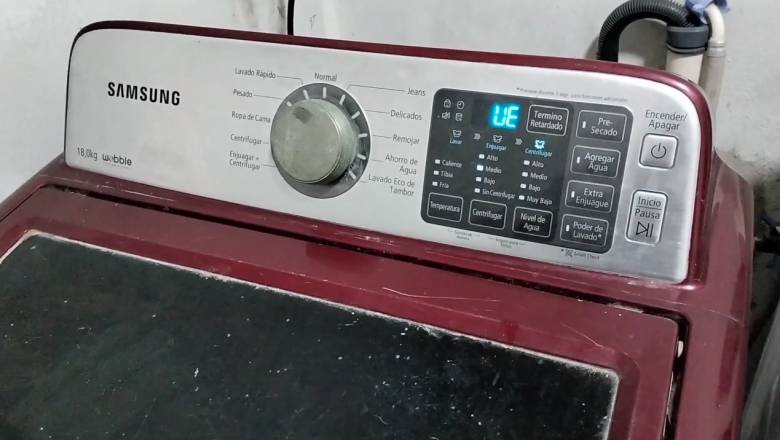
Samsung Washer UE Error Code — Causes and Step-by-Step Fix

The UE error code on a Samsung washing machine means the unit detected an unbalanced load during the spin cycle and stopped spinning as a safety measure. According to Samsung's official support documentation, the UE (also displayed as UB, E4, or DC on some models) indicates that clothes inside the drum are not evenly distributed, causing excessive vibration. In approximately 60% of cases, the fix is simply redistributing the laundry — a 2-minute solution.
The Samsung washer UE error code means the washing machine's control board detected an unbalanced load during the spin cycle and automatically stopped the drum rotation as a safety measure. When laundry bunches up on one side of the drum, the resulting vibration exceeds the machine's tolerance threshold and the control board halts spinning to prevent damage to the bearings, suspension system, and surrounding cabinetry.
DIY fix success rate: approximately 90% of UE errors resolved without a technician. Most common fix: redistributing laundry inside the drum (60% of cases, takes 2 minutes). Average repair time for mechanical causes: 20–45 minutes. Professional repair cost (when needed): $150–$350 for suspension rod or shock absorber replacement.
Samsung uses several code variants depending on the model and region — UE, UB, E4, and DC all indicate the same unbalanced load condition. This guide covers every cause from the simplest (just rearranging clothes) to the most complex (worn suspension components), with specific part numbers, calibration procedures, and prevention tips so you can stop UE errors from recurring.
What Does the UE Error Code Mean on a Samsung Washer?
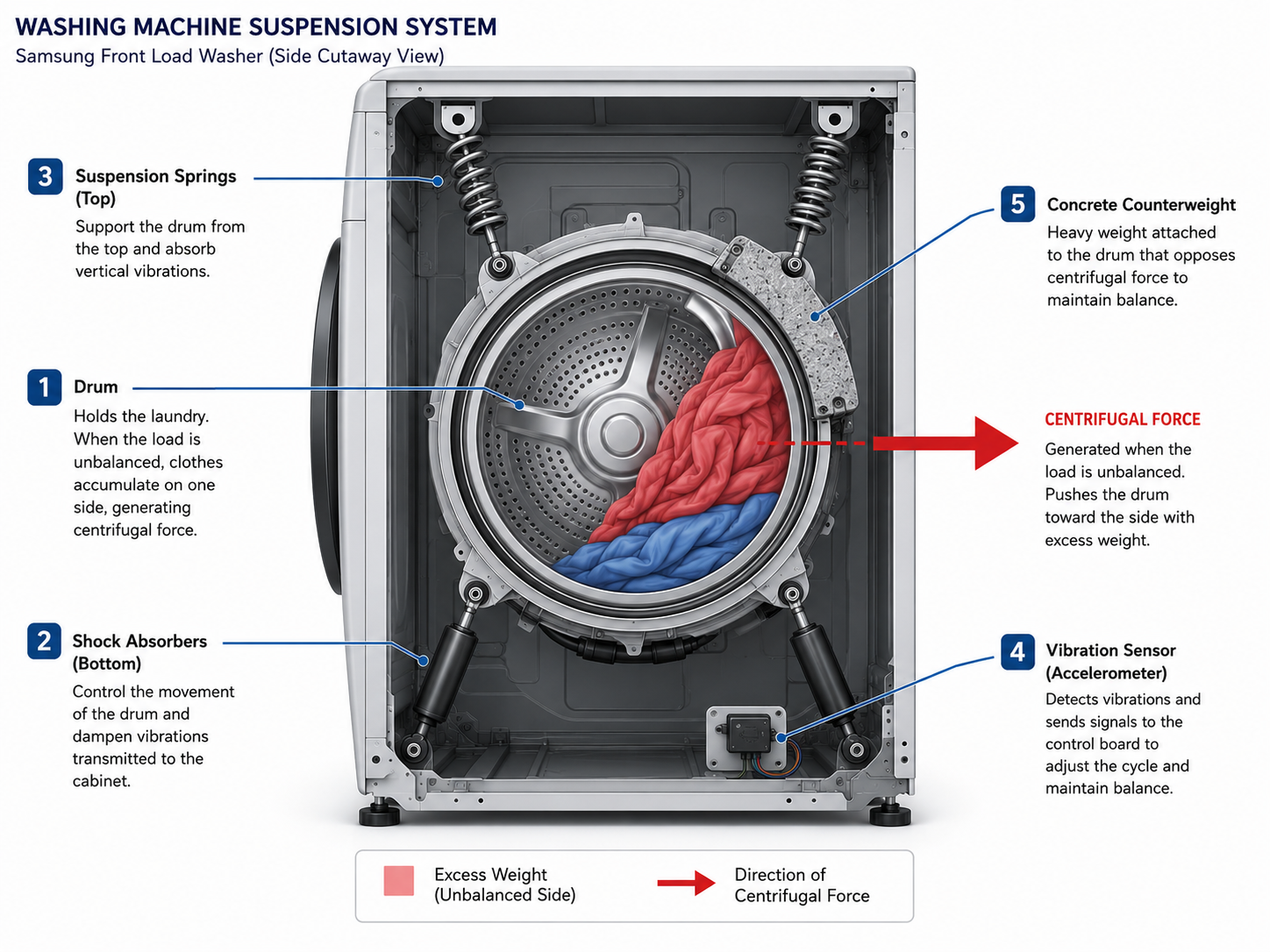
UE stands for "Unbalanced Error" — Samsung's designation for a drum load distribution fault detected during the spin cycle. Modern Samsung washers spin at speeds between 1,000 and 1,400 RPM during the final spin. At those speeds, even a slight weight imbalance creates powerful centrifugal forces that can damage internal components and cause the machine to "walk" across the floor.
The washer's vibration sensor (accelerometer) continuously monitors drum movement. When vibration exceeds the programmed threshold, the control board attempts to rebalance by slowing down, redistributing water, and restarting the spin up to 3 times automatically. If rebalancing fails after all retry attempts, the machine halts completely and displays UE.
Code variants across Samsung models:
- UE — Most common display on front-load models manufactured 2017 and later.
- UB — Displayed on some front-load models during the automatic rebalancing attempts (before the final UE). If UB resolves on its own, the cycle continues.
- DC — Used on older Samsung top-load models (pre-2017) for the same unbalanced condition.
- E4 — Used on some older Samsung front-load models and region-specific units.
All four codes indicate the identical problem and the troubleshooting steps are the same regardless of which variant your display shows.
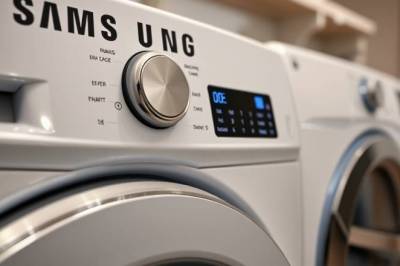
Important distinction from other codes:
- UE/UB/DC/E4 — Unbalanced load (mechanical balance issue).
- 3E/EA — Motor error (the motor itself is failing, not a balance issue).
- dE — Door error (door not properly latched, preventing spin).
- OE/5E — Drain error (water cannot exit, different system entirely).
If your Samsung washer displays UE specifically, the problem is always related to load distribution, machine leveling, or the suspension system — never the motor, drain, or electronics directly.
Common Causes of the Samsung Washer UE Error
Based on Samsung's support documentation and appliance repair service data, here are the causes ranked by frequency:
1. Unevenly distributed laundry (approximately 60% of cases)
This is overwhelmingly the most common trigger. Heavy items like jeans, towels, blankets, or comforters tend to clump together on one side of the drum during the wash cycle. A single heavy item (like a bath mat) without a counterbalancing load creates severe imbalance. Samsung's support explicitly states that washing a single bulky item alone — without adding smaller items for balance — is the primary cause of UE errors.
2. Washer not level (approximately 15% of cases)
If the washer is not sitting perfectly level on the floor, the drum's center of gravity shifts slightly, making it much easier for loads to trigger the vibration threshold. Even a small tilt (invisible to the eye but detectable with a spirit level) significantly reduces the machine's tolerance for minor imbalances that would otherwise self-correct. Common causes: uneven flooring, leveling feet not properly adjusted, or locking nuts that vibrated loose over time.
3. Overloading or underloading the drum (approximately 10% of cases)
An overloaded drum cannot redistribute clothes during the pre-spin redistribution phase because items are packed too tightly. Conversely, an underloaded drum (only 1–2 small items) has nothing to counterbalance against, and a single item clinging to the drum wall creates immediate imbalance at spin speed. Samsung recommends loading the drum to approximately 75% capacity for optimal balance.
4. Worn shock absorbers or suspension rods (approximately 8% of cases)
Front-load Samsung washers use two shock absorbers (hydraulic dampers) at the bottom of the tub and two springs at the top. Top-load models use four suspension rods connecting the tub to the frame. These components absorb vibration during spinning. When they wear out (typically after 5–8 years of regular use), they lose their damping ability, and the tub moves excessively during spin — triggering UE even with perfectly balanced loads. A clear sign of worn suspension: the drum bounces visibly when you push down on it and release.
5. Shipping bolts not removed (approximately 4% of cases — new installations)
Samsung front-load washers ship with 3–4 transit bolts that lock the drum in place during transport. If these bolts are not removed during installation, the drum cannot float freely on its suspension system and will vibrate excessively during every spin cycle. This is the most common cause of UE on brand-new washers. The bolts are located on the back panel and are covered in the installation guide that ships with the unit.
6. Worn drum bearings (approximately 2% of cases)
The drum spins on a central bearing assembly. When bearings wear (usually after 7–10 years), the drum develops excessive play — a slight wobble that grows worse at high spin speeds. Bearing failure is typically accompanied by a loud grinding, rumbling, or roaring noise during spin that gets progressively louder over weeks. This is the most expensive repair (often $300–$500+ for parts and labor) and on older washers may justify replacement over repair.
7. Calibration loss after power interruption (approximately 1% of cases)
Samsung washers store vibration calibration data in the control board. A power surge, outage, or accidental unplugging during a cycle can corrupt this calibration, making the sensor overly sensitive and triggering UE prematurely even with balanced loads. Running the calibration mode resets these parameters.
Key diagnostic fact: If UE appears only occasionally (once every 10–20 loads), the cause is almost always load distribution (cause #1) — solved by adjusting laundry habits. If UE appears on every cycle regardless of load size and distribution, the cause is mechanical (causes #2, #4, #5, or #6) — requiring physical inspection or repair.
How to Fix the Samsung Washer UE Error — Step by Step
Follow these steps in order from simplest to most complex. Each step addresses one potential cause. Most users resolve UE within Steps 1–3 without tools or cost.
Step 1: Redistribute the laundry (immediate fix)
This resolves the majority of UE errors instantly:
- Pause the cycle — Press the Start/Pause button. Wait for the door to unlock (front-loaders may take 1–2 minutes to drain enough water for the door lock to release).
- Open the door and look at how the clothes are distributed. You will typically find a heavy item (jeans, towel, blanket) bunched on one side.
- Redistribute evenly — Spread heavy items to opposite sides of the drum. If you're washing a single large item (like a comforter), add 3–4 bath towels to provide counterweight.
- Close the door and press Start — The cycle will resume from where it stopped.
If the door won't unlock: Select the "Spin" cycle and set the spin speed to "No Spin." Press Start. This triggers a drain mode that lowers the water level enough to release the door lock. Once drained, you can open the door and redistribute.
Step 2: Level the washing machine
If UE recurs frequently even with balanced loads, the machine likely needs leveling:
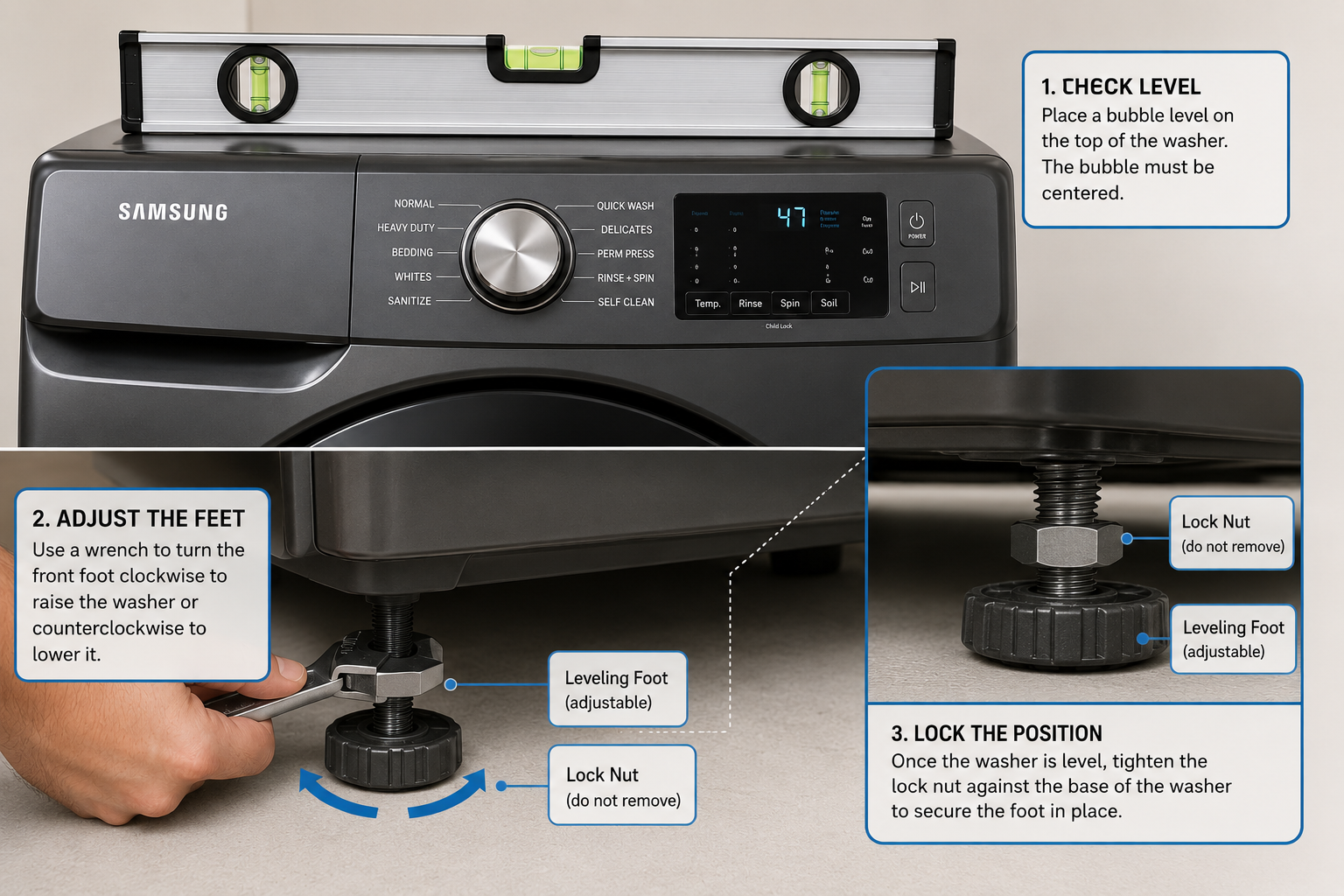
- Place a spirit level on top of the washer — Check both side-to-side and front-to-back. The bubble must be centered in both directions.
- Adjust the leveling feet — Samsung washers have adjustable feet at all four corners. Turn the feet clockwise to raise or counterclockwise to lower. Adjust until the spirit level reads perfectly level in both orientations.
- Tighten the lock nuts — Each foot has a locking nut above it. Once leveled, tighten the nut against the washer frame to prevent the foot from vibrating loose over time. Use a wrench for this — hand-tight is not sufficient.
- Rock test — Push the washer at each corner. It should NOT rock at all. If it rocks diagonally, one foot is too short. Re-adjust until all four corners are firmly planted.
- Floor assessment — If your laundry room has a wood subfloor that flexes, consider placing the washer on a solid concrete paver or anti-vibration pads ($20–$40 for a set of 4). A flexing floor amplifies vibration regardless of leveling.
Step 3: Run the calibration mode
Samsung washers have a built-in calibration mode that resets the vibration sensor parameters. This is especially useful if UE started occurring after a power outage or if you recently moved the machine:
For front-load models (WF series):
- Remove all laundry from the drum. The drum must be completely empty.
- Turn on the washer by pressing the Power button.
- Press and hold the Temp and Delay End buttons simultaneously for 3 seconds (on some models, it's Temp + Rinse, or you enter "Calibration" via the Smart Control app — check your specific model manual).
- The display will show "Cb" or "CLb" indicating calibration mode.
- Press Start. The drum will rotate slowly in both directions for approximately 3 minutes, during which the control board recalibrates the vibration sensor baseline.
- When complete, the display returns to normal. Power off and back on.
For top-load models (WA series):
- Remove all laundry. The drum must be empty.
- Turn on the washer.
- Press and hold Delay End + Soil Level (or Temp + Rinse on some models) for 3 seconds.
- "Cb" appears on the display.
- Press Start. The tub rotates slowly for about 3 minutes to calibrate.
- Power cycle the washer when complete.
Samsung recommends running calibration mode: after initial installation, after relocating the washer, after any power interruption during a cycle, and if UE errors increase in frequency without an obvious load-related cause.
Step 4: Check for shipping bolts (new installations only)
If your Samsung washer is newly installed and shows UE on every cycle:
- Check the back of the machine. Look for 3–4 large bolts (typically with red or orange plastic spacers) inserted into the rear panel.
- If present, remove them immediately. Use a 17mm wrench or socket. These are transit bolts that lock the drum in a fixed position for shipping. With the bolts in place, the drum cannot move on its suspension, causing extreme vibration during spin.
- Install the plastic hole covers (included in the accessory bag that came with the washer) into the empty bolt holes to prevent dust and insects from entering.
- Keep the bolts. Store them in a labeled bag taped to the back of the washer. You will need them again if you ever move the washer to a new location.
Step 5: Inspect shock absorbers and suspension (recurring UE on every load)
If UE occurs on every cycle regardless of load distribution and the machine is properly leveled, the suspension system is likely worn:
For front-load models:
- The push test: Open the door, firmly push down on the drum (the metal tub inside) and release. A healthy suspension allows the drum to bounce once and settle immediately. If the drum bounces 2–3 times or more like a trampoline, the shock absorbers are worn.
- Access the shock absorbers: Remove the front lower panel (kickplate, 2–3 screws) and optionally the main front panel (varies by model, typically 6–8 screws plus the door boot clamp). The two shock absorbers connect diagonally from the bottom of the outer tub to the washer frame.
- Visual inspection: Look for oil leaks (hydraulic fluid seeping from the cylinder body), broken mounting brackets, or compressed/deformed rubber bushings at the mounting points.
- Replacement: Common Samsung front-load shock absorber part numbers include DC66-00470A (fits WF42H5000, WF45R6100, WF50B6300 and many others) and DC66-00650D. Priced $20–$50 per pair. Always replace both shock absorbers at the same time — a new one paired with a worn one creates uneven damping.
For top-load models:
- Listen during spin: A loud banging or thumping (distinct from the slapping sound of unbalanced clothes) indicates suspension rods have lost their damping ability.
- Access the rods: Unplug the washer. Remove the top panel (clips or screws at rear). The four suspension rods connect from the frame at top/bottom to the tub. Each rod has a spring mechanism and a rubber damper cap.
- Inspect: Check for bent rods, cracked/missing rubber caps at the ends, or stretched springs. A rod should provide firm resistance when you push up on the tub — if the tub moves freely without resistance, the rods need replacement.
- Replacement: Common Samsung top-load suspension rod part number is DC97-16350C (set of 4, fits WA50R5200, WA52A5500, and most WA-series models). Priced $40–$80 for a complete set of 4. Replace all four simultaneously.
Step 6: Check for worn drum bearings (last resort)
If the suspension is healthy but UE persists, especially with a loud rumbling/grinding noise during spin:
- The spin-by-hand test: With the washer off and empty, spin the drum by hand. It should rotate smoothly and silently. A gritty, grinding, or rough feeling indicates worn bearings.
- The play test: Grab the drum at the opening and try to lift/tilt it. There should be virtually zero play. If you can move the drum noticeably up/down or front/back, the bearings have excessive clearance.
- Bearing replacement is a major repair — it typically requires removing the outer tub, splitting it open (on models with a two-piece tub), pressing out the old bearing/seal, and pressing in new ones. Parts cost $50–$100, but labor is intensive (2–4 hours). Total professional cost: $300–$500+.
- Replacement consideration: On washers older than 7–8 years, many repair professionals advise against bearing replacement because the cost approaches 50% or more of a new washer's price. Evaluate based on the machine's age and overall condition.
How to Prevent UE Errors — Loading Best Practices
Since the majority of UE errors stem from how laundry is loaded, adopting these habits eliminates most occurrences entirely:
- Mix heavy and light items in every load. Never wash heavy items (jeans, towels, blankets) alone. Add lighter items (t-shirts, pillowcases) to provide counterbalance. Samsung recommends at least 3–4 items of varying weight per load.
- Load to 75% capacity. Too few items and too many items both cause imbalance. The sweet spot is filling the drum approximately three-quarters full — enough items to distribute weight evenly, with enough space for items to tumble freely.
- Spread items loosely around the drum. Do not bunch or stuff clothes in one area. Distribute them evenly around the entire circumference of the drum before starting the cycle.
- Wash bulky items on the Bedding or Bulky cycle. Samsung washers have a dedicated Bedding/Bulky cycle that uses a slower spin speed and extra redistribution attempts specifically designed for heavy, large items like comforters, duvets, and sleeping bags.
- Separate items that tangle. Long items like sheets, duvet covers, and curtains wrap around smaller items and clump together. Wash these separately or use mesh laundry bags to prevent tangling.
- Avoid washing a single item alone. A lone heavy item (one pair of jeans, one wet towel) will always migrate to one side during spin. Add additional items or combine with the next load.
- Redistribute laundry stuck to the door seal. In front-load washers, items can get wedged between the door boot gasket and the drum. Check for trapped clothing before starting the spin cycle if you notice an item stuck against the glass.
Samsung's official recommendation: Wash loads of mixed fabric types and weights. For a single large item like a blanket, add 4–6 bath towels distributed evenly to provide counterweight. This single habit prevents approximately 60% of all UE error occurrences.
When to Call a Professional
Contact a certified appliance repair technician if:
- You've completed Steps 1–4 (redistribution, leveling, calibration, shipping bolt check) and UE still appears on every cycle regardless of load type and size — this strongly indicates worn mechanical components.
- You hear a loud grinding, rumbling, or roaring noise during spin that has gotten progressively worse over weeks or months — this suggests drum bearing failure, which requires specialized tools (bearing press) to repair properly.
- The drum visibly wobbles or shakes violently during spin even when empty — indicating failed suspension components or bearing damage beyond DIY repair scope.
- You notice oil or dark fluid leaking beneath the washer — this is hydraulic fluid from a failed shock absorber or dampener, confirming suspension failure.
- Your Samsung washer is under warranty — Samsung provides a standard 1-year full warranty on parts and labor, plus a 3-year warranty on the stainless steel tub and a 20-year warranty on the Digital Inverter Motor (the motor itself, not the entire drivetrain). If your unit is within these windows, do not attempt repairs yourself as it may void coverage.
- The washer is less than 30 days old and UE appears on every load — contact Samsung directly. This may qualify for an exchange under their satisfaction guarantee rather than a repair.
Average professional repair cost for recurring UE errors: Shock absorber replacement: $150–$250 total (parts + labor). Suspension rod replacement (top-load): $120–$200 total. Drum bearing replacement: $300–$500+ total. Diagnostic fee: $75–$100, typically credited toward the repair.
For Samsung warranty service in the United States, contact Samsung at 1-800-726-7864 or submit a service request at samsung.com/us/support. For top-load models with the 20-year motor warranty, note that the warranty covers the motor only — not the drum bearings, suspension, or control board. Have your model number (on the label inside the door frame) and purchase date ready when calling.
Samsung Washer Models Commonly Affected by UE Error
The UE error code appears across all Samsung washing machine lines — both front-load and top-load — because all models use the same vibration detection logic. However, these popular series see the highest volume of UE reports due to their market share and high-speed spin capabilities:
Front-Load Models (WF series):
- WF45B6300 series (WF45B6300AW, WF45B6300AP) — 4.5 cu. ft. with Super Speed Wash. One of Samsung's best-selling front-loaders in 2023–2026.
- WF50B6300 series (WF50B6300AW) — 5.0 cu. ft. large capacity with AI Smart Dial.
- WF42H5000 series (WF42H5000AW) — Popular budget front-loader, 4.2 cu. ft.
- WF45R6100 series (WF45R6100AW, WF45R6100AZ) — 4.5 cu. ft. with Steam Sanitize+.
- WF45T6000 series (WF45T6000AW) — Entry-level 4.5 cu. ft. front-loader.
Top-Load Models (WA series):
- WA50R5200 series (WA50R5200AW) — 5.0 cu. ft. top-load with Active WaterJet.
- WA52A5500 series (WA52A5500AV) — 5.2 cu. ft. large capacity with built-in sink.
- WA54CG7150 series (WA54CG7150AW) — 5.4 cu. ft. Smart top-load, 2024+ model.
- WA55A7300 series (WA55A7300AE) — 5.5 cu. ft. mega capacity top-load.
The diagnostic and repair steps in this guide apply to all Samsung washers displaying UE, UB, DC, or E4. The primary differences between models are:
- Suspension type: Front-load models use shock absorbers (2) + springs (2). Top-load models use suspension rods (4) with damper caps.
- Calibration button combination: Varies by model year. Check your user manual or Samsung's support page for your specific model.
- Shipping bolts: Front-load models have 3–4 rear transit bolts. Top-load models typically have a single foam spacer between the tub and frame that must be removed during installation.
UE Error vs. Normal Vibration: When to Worry
Some vibration during the spin cycle is completely normal. Samsung washers spin at speeds up to 1,400 RPM — a certain amount of movement, noise, and vibration is expected physics. Here's how to distinguish between normal operation and genuine problems:
Normal (no action needed):
- Slight humming and vibration during high-speed spin.
- Brief thumping sounds as the drum accelerates through spin speeds (the load is settling).
- UB code appearing briefly (1–2 seconds) then disappearing as the washer self-corrects — this is the automatic rebalancing working as designed.
- UE appearing once every 15–20+ loads, always with a specific type of load (heavy blanket, single item). This is a loading habit issue, not a machine problem.
Abnormal (investigate further):
- UE appearing on every load regardless of what you wash or how you distribute it.
- Violent shaking that moves the washer across the floor (more than 1 inch per cycle).
- Loud grinding, rumbling, or metallic scraping during spin (bearing noise).
- Visible oil or dark fluid underneath the washer (shock absorber failure).
- The drum bouncing 3+ times when you push down and release (failed suspension).
- New washer (under 30 days) showing UE on every cycle — likely shipping bolts not removed.
If your situation matches the "Normal" column, adjusting your loading habits (Step 1) and ensuring the machine is level (Step 2) is all you need. If it matches "Abnormal," proceed to Steps 4–6 for mechanical diagnosis.
Preventing Long-Term Suspension Wear
The suspension system (shock absorbers, springs, and rods) is a wear item — it will eventually degrade on any washer. However, you can significantly extend its lifespan with these practices:
- Keep the washer level at all times. Check level every 6 months. Vibration gradually loosens the leveling feet, shifting the machine off-level over time. A quarterly check and re-tightening of lock nuts prevents this.
- Avoid consistent overloading. Running the washer at maximum capacity every single load puts constant maximum stress on the shock absorbers. Keeping loads at 75% capacity reduces mechanical stress by approximately 30%.
- Use the correct spin speed for the load type. Delicate or bulky items don't need 1,400 RPM. Samsung washers allow manual spin speed reduction. Using 800 RPM for bedding and bulky items reduces the centrifugal force the suspension must handle.
- Address UE errors immediately. Running the washer through repeated UE error cycles (where it tries to spin, fails, retries, fails again) puts additional stress on the suspension system with every failed attempt. Fix the balance issue before restarting the cycle.
- Consider anti-vibration pads. Rubber anti-vibration pads ($20–$40 for a set of 4) placed under each foot absorb vibration that would otherwise transfer between the washer and floor. They don't prevent UE errors directly, but they reduce the cumulative mechanical stress on the frame and suspension mounts.
- Clean the drain filter monthly. A partially clogged drain filter causes incomplete water removal during the drain phase before spin. Residual water adds significant weight to the drum, increasing imbalance forces during spin. The heavier the drum at spin start, the harder the suspension works.
Expected suspension component lifespan: Shock absorbers (front-load): 6–10 years with proper care, 3–5 years with chronic overloading. Suspension rods (top-load): 7–12 years. Drum bearings: 8–12 years under normal use. Proactive leveling checks and balanced loading habits are the single most effective way to maximize these lifespans.