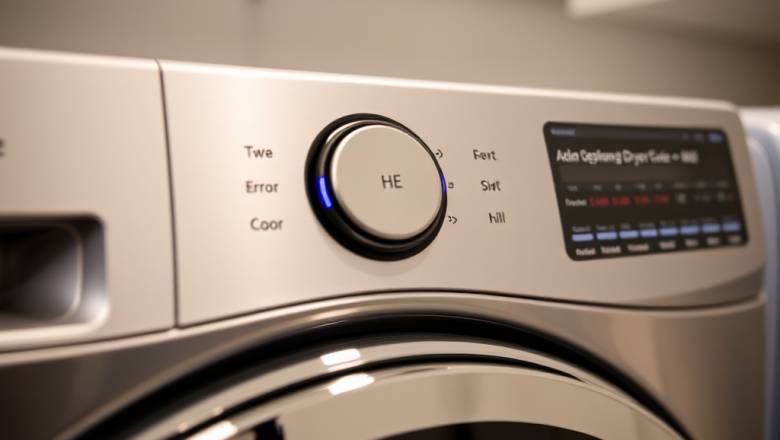
Samsung Dryer HE Error Code — Causes and Step-by-Step Fix

The HE error code on a Samsung dryer means the appliance detected an overheating condition and shut down the heating element as a safety precaution. According to Samsung's official troubleshooting documentation, HE (also displayed as HC, hE, or HC4 on certain models) indicates the dryer's internal temperature exceeded safe operating limits. In approximately 50% of cases, the root cause is a clogged lint filter or restricted exhaust vent that traps hot air inside the drum. A thorough vent cleaning resolves most HE errors within 15–30 minutes without replacing any parts.
The Samsung dryer HE error code means the appliance's control board detected a temperature anomaly — either the drum air temperature exceeded the safe threshold or the thermistor reported readings outside its programmed range. The dryer immediately disables the heating element to prevent fire hazard, fabric damage, or component failure. This is a protective shutdown, not a catastrophic failure.
DIY fix success rate: approximately 85% of HE errors resolved without a technician. Most common fix: cleaning the lint filter and clearing the exhaust vent (50% of cases, takes 15–30 minutes). Average professional repair cost when parts are needed: $120–$280. Samsung-recommended vent cleaning frequency: every 12 months or when drying times exceed 50 minutes per load.
Samsung uses several heating-related error code variants depending on the model year and region — HE, HC, hE, and HC4 all relate to temperature regulation failures. This guide covers the complete diagnostic path from the simplest fix (lint buildup) through thermistor replacement and control board diagnosis, with specific part numbers and multimeter readings for each test. 140
What Does the HE Error Code Mean on a Samsung Dryer?
HE stands for "Heating Error" — Samsung's designation for a condition where the dryer's temperature control system has detected abnormal heat levels or sensor readings. The dryer uses a thermistor (temperature-sensitive resistor) mounted inside the drum housing to continuously monitor air temperature during operation. When readings fall outside the expected range for the selected cycle, the control board triggers HE and cuts power to the heating element.
The system operates on two safety principles: if temperature is too high (overheating), it shuts down to prevent fire; if the thermistor reads erratically or reports an open/short circuit, it shuts down because it cannot confirm safe operation.
Code variants across Samsung dryer models:
- HE — General heating error on most models. Indicates the dryer cannot maintain proper temperature regulation.
- HC — "High temperature Celsius" — the thermistor detected temperature exceeding the safe limit for the selected cycle. Often seen on models manufactured 2018 and later.
- hE — Lowercase variant of HE displayed on some older LED panels. Same meaning.
- HC4 — Specific variant indicating the exhaust temperature sensor (not drum sensor) detected overheating at the vent outlet. Points specifically to vent restriction.
Important distinction from other codes:
- HE/HC — Temperature too high or thermistor fault (this guide).
- tS/tC — Thermistor signal error. The sensor's electrical connection is broken, not necessarily an overheating condition.
- dC/dE — Door error (door not latched, unrelated to heating).
- 9C1/9E — Voltage error (power supply issue, not heating element).
If your Samsung dryer displays HE or HC specifically, the problem is always related to airflow restriction, thermistor failure, or heating element malfunction. 141
Common Causes of the Samsung Dryer HE Error
Based on Samsung's service documentation and appliance repair industry data, here are the causes ranked by frequency:
1. Clogged lint filter or restricted exhaust vent (approximately 50% of cases)
This is the most common cause by a wide margin. When the lint trap is packed with debris or the exhaust duct is partially blocked, hot air cannot escape the drum efficiently. The trapped heat causes internal temperatures to climb above the safe threshold. A dryer vent that hasn't been cleaned in over 12 months is the single biggest risk factor for HE errors. According to the U.S. Consumer Product Safety Commission, restricted dryer vents are also responsible for approximately 2,900 residential fires annually — making this a safety issue beyond just an error code.
Key statistic: A partially blocked vent can increase drum temperature by 30–50°F above normal operating range. Samsung dryers typically operate at 125–135°F for regular cycles and up to 150°F for sanitize cycles. The HE threshold triggers at approximately 165–175°F measured at the exhaust thermistor location.
2. Faulty thermistor (approximately 25% of cases)
The thermistor is a small sensor (roughly the size of a coin) mounted inside the drum housing or at the exhaust outlet. It measures temperature by changing its electrical resistance as temperature changes. When the thermistor degrades (common after 5–8 years), it sends erratic readings to the control board — sometimes reporting dangerously high temperatures that aren't actually present. The control board cannot distinguish between a real overheating event and a faulty sensor, so it triggers HE as a precaution.
3. Blocked internal lint buildup (approximately 12% of cases)
Even with regular lint trap cleaning, fine lint particles bypass the filter over time and accumulate inside the dryer cabinet — around the heating element housing, blower wheel, and moisture sensor bars. This internal lint restricts airflow within the machine itself (separate from the external vent duct) and can directly contact the heating element, creating both a fire hazard and an overheating condition.
4. Failed heating element (approximately 8% of cases)
Electric Samsung dryers use a coiled nichrome wire heating element that can develop "grounding" — where the wire sags and touches the metal housing. When grounded, the element runs at full power continuously, ignoring the control board's off signals. This causes genuine overheating and triggers HE. A grounded heating element is identifiable with a multimeter continuity test between the element terminals and the metal housing.
5. Crushed or kinked exhaust duct (approximately 5% of cases)
When the dryer is pushed too close to the wall, the flexible exhaust duct (usually aluminum foil or semi-rigid aluminum) gets crushed or kinked. A 90% reduction in duct diameter at the kink creates the same airflow restriction as a fully clogged vent. This is especially common after the dryer has been moved for cleaning or repairs and pushed back without checking the duct. 142
How to Fix the Samsung Dryer HE Error — Step by Step
Follow these steps in order from simplest to most complex. Most HE errors resolve within Steps 1–2.
Step 1: Clean the lint filter and reset the dryer
- Remove the lint filter (located inside the door opening or on top of the dryer depending on model). If the mesh is visibly packed with lint, this is likely your cause.
- Clean the filter thoroughly. Remove all lint by hand, then wash the filter with warm soapy water using a soft brush. Rinse completely and allow to dry. Fabric softener residue creates an invisible film on the mesh that blocks airflow even when it appears clean — washing removes this buildup.
- Vacuum the lint trap housing. Use a narrow vacuum attachment or a long flexible lint brush to clean inside the slot where the filter sits. Lint accumulates here where you can't see it.
- Reset the dryer: Unplug the dryer from the wall outlet (or switch off the circuit breaker) for 60 seconds. This clears the error code from the control board memory. Plug back in and attempt a cycle.
If the error clears and the dryer operates normally, monitor the next 3–5 cycles. If HE returns, proceed to Step 2.
Step 2: Inspect and clean the exhaust vent duct
This is the critical step that resolves the majority of HE errors:
- Pull the dryer away from the wall far enough to access the back. Disconnect the exhaust duct from the dryer's exhaust outlet (usually a 4-inch diameter clamp connection).
- Inspect the duct visually. Look inside for lint accumulation, kinks, or crushing. If you can see lint buildup, the duct needs cleaning.
- Clean the entire duct run. Use a dryer vent cleaning kit (a flexible rod with a brush head, available for $20–$40 at hardware stores). Push the brush through from the dryer end to the exterior wall outlet. Remove all accumulated lint.
- Check the exterior vent hood. Go outside and locate where the duct exits your home. Remove the vent cover and clear any lint, bird nests, or debris blocking the flap. The flap should swing freely.
- Inspect duct length and routing. Samsung recommends a maximum exhaust duct length of 35 feet for a straight run, reduced by 5 feet for each 90-degree elbow. If your duct exceeds this, airflow will be permanently insufficient. Replace flexible foil duct with smooth-wall semi-rigid or rigid metal duct to reduce resistance.
- Reconnect and test. Reattach the duct, push the dryer back (leaving at least 4 inches of clearance behind), and run a timed-dry cycle for 10 minutes. Check that air is flowing strongly from the exterior vent hood during operation — you should feel warm air pushing out.
Professional vent cleaning service cost: $100–$170 average. DIY cost with a vent brush kit: $25–$40 (one-time purchase, reusable). Samsung's maintenance recommendation: clean the full vent duct from dryer to exterior every 12 months, or sooner if drying cycles take longer than 50 minutes for a normal load.
Step 3: Test the thermistor with a multimeter
If vent cleaning didn't resolve HE, the thermistor may be faulty:
- Unplug the dryer from the wall outlet. Safety first — never work on an energized appliance.
- Locate the thermistor. On most Samsung dryers, the thermistor is mounted on the blower housing or inside the drum housing near the heating element. Access typically requires removing the top panel and front panel (electric models) or the rear panel (gas models). Consult your model's service manual for exact location.
- Disconnect the thermistor wiring harness. It typically has a 2-pin connector.
- Measure resistance with a multimeter. Set the multimeter to the ohms (Ω) setting. Touch the probes to the two thermistor terminals.
- Expected reading at room temperature (25°C/77°F): approximately 10,000 ohms (10kΩ). The reading should be between 8,000Ω and 12,000Ω at normal room temperature. If the reading is 0Ω (short circuit), infinite/OL (open circuit), or wildly outside the 8k–12k range, the thermistor has failed.
- Replace if faulty. Common Samsung dryer thermistor part number: DC32-00007A (fits DV42H5000, DV45K6500, DV50B6300, DVE45B6300, and many other models). Priced $8–$20. Installation takes 10–15 minutes once the panels are removed.
Step 4: Inspect the heating element for grounding
If the thermistor tests good but HE persists, check the heating element:
- Locate the heating element assembly. On Samsung electric dryers, it's typically in the lower rear section of the cabinet, housed in a metal can with 2 electrical terminals.
- Visual inspection: Remove the element housing cover and look at the coiled wire. It should be uniformly suspended on ceramic insulators without any section touching the metal housing. If a section has sagged and contacts the metal, the element is "grounded" and must be replaced.
- Multimeter test for grounding: Set the multimeter to continuity. Touch one probe to either heating element terminal and the other probe to the metal housing. If continuity exists (beep or near-zero reading), the element is grounded and must be replaced.
- Multimeter test for element integrity: Measure resistance between the two element terminals. A working Samsung dryer heating element should read between 7–20 ohms (varies by model wattage). If the reading is infinite (OL), the element is broken/open and has no continuity.
- Replacement: Common Samsung dryer heating element part number: DC47-00019A (fits most DV-series electric dryers). Priced $25–$60. Element replacement involves disconnecting the wiring, removing 1–2 mounting screws, and sliding the old element out.
Step 5: Check for internal lint buildup
- With the panels already removed from Step 3–4, vacuum all visible lint from inside the cabinet — especially around the heating element housing, blower wheel area, and moisture sensor bars.
- Check the blower wheel for lint wrapped around the shaft or blades, which reduces airflow volume.
- Reassemble, reconnect power, and test.
When to Call a Professional
Contact a certified appliance repair technician if:
- You've completed vent cleaning, thermistor testing, and heating element inspection and HE still appears — this may indicate a control board fault where the board itself is misinterpreting sensor data.
- You smell burning during dryer operation — this could indicate lint contacting the heating element or an electrical wiring issue. Stop using the dryer immediately until inspected.
- The dryer runs but produces no heat at all after clearing HE — in gas dryers, this could indicate a failed gas valve coil or igniter, which requires safe gas line handling.
- You are uncomfortable using a multimeter or removing dryer panels — the heating element operates at 240V and working inside a dryer involves proximity to high-voltage wiring. If unsure, professional service is the safer choice.
- Your Samsung dryer is under warranty — Samsung provides a 1-year full warranty on parts and labor. Some retailers offer extended protection plans. DIY repairs on in-warranty units may void coverage.
Average professional repair costs for HE errors: Thermistor replacement: $100–$150 total (parts + labor). Heating element replacement: $150–$250 total. Full vent cleaning (professional service): $100–$170. Control board replacement: $250–$400 total. Diagnostic service fee: $75–$100, typically credited toward repair. 144
How to Prevent Samsung Dryer HE Errors
Since the majority of HE errors stem from airflow restriction, these maintenance habits prevent most occurrences:
- Clean the lint filter after every single load. This is the single most impactful prevention habit. A clean filter maintains optimal airflow through the drum.
- Wash the lint filter monthly. Use warm water and dish soap with a soft brush. Fabric softener sheets deposit an invisible waxy film on the mesh that blocks airflow even when the filter looks clean. Hold the filter under running water — if water pools on the mesh instead of passing through, the film is present.
- Clean the exhaust vent duct annually. Schedule professional vent cleaning or use a DIY brush kit once per year. Mark it on your calendar. This single annual task prevents approximately 50% of all HE error occurrences.
- Use rigid metal duct instead of foil flex. Smooth-wall rigid aluminum duct provides significantly better airflow and collects less lint than corrugated flexible duct. If your current installation uses flexible foil, upgrading to rigid duct reduces HE risk and improves drying performance.
- Maintain 4+ inches of clearance behind the dryer. A crushed duct is a restricted duct. Never push the dryer flush against the wall.
- Do not overload the dryer. An overstuffed drum restricts air circulation within the drum itself. Samsung recommends filling the drum to approximately 75% capacity for optimal airflow and drying efficiency.
- Monitor drying times. If a normal load that used to dry in 40 minutes now takes 60+ minutes, your vent is accumulating lint. Clean it before the buildup triggers HE.
Samsung Dryer Models Commonly Affected by HE Error
The HE error code appears across all Samsung electric and gas dryer models because all share the same thermistor-based temperature monitoring system. These popular models see the highest volume of HE reports due to market share:
Electric Dryer Models (DV/DVE series):
- DVE45B6300 series (DVE45B6300AW, DVE45B6300AP) — 7.5 cu. ft. with Steam Sanitize+. One of Samsung's top-selling electric dryers 2023–2026.
- DV45K6500 series (DV45K6500EW, DV45K6500EV) — 7.5 cu. ft. with Multi-Steam technology.
- DVE50B6300 series (DVE50B6300AE) — Large capacity 7.6 cu. ft. with AI Smart Dial.
- DV42H5000 series (DV42H5000EW) — 7.5 cu. ft. budget electric dryer, very high sales volume.
- DVE45T6000 series (DVE45T6000W) — 7.5 cu. ft. entry-level front-load dryer.
Gas Dryer Models (DVG series):
- DVG45B6300 series — Gas equivalent of the DVE45B6300, same temperature monitoring.
- DVG50B6300 series — Large capacity gas dryer with Smart Dial.
The diagnostic and repair steps in this guide apply to all Samsung dryers displaying HE, HC, hE, or HC4. The primary differences between electric and gas models for HE diagnosis are:
- Electric models: Heating element is a coiled wire that can ground. Test with multimeter.
- Gas models: Heat comes from a gas burner. HE in gas models typically points to thermistor failure or vent restriction only — the gas valve and igniter produce different error codes (gS, FE) when they fail.