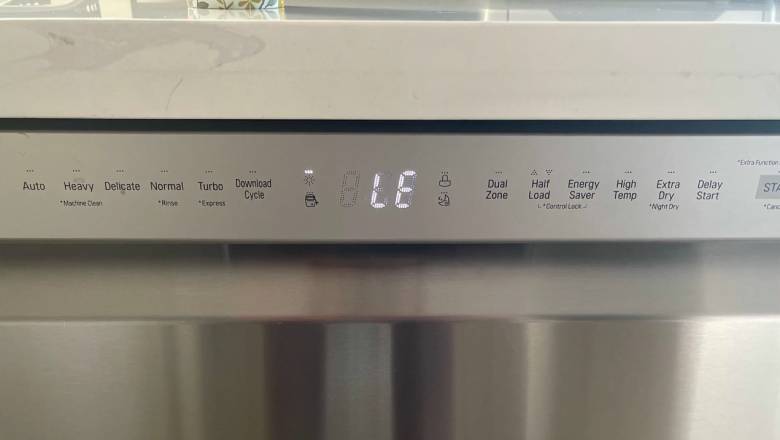
LG Dishwasher LE Error Code — Causes and Step-by-Step Fix

The LE error code on an LG dishwasher means the main control board cannot detect proper rotation of the wash circulation motor. According to LG's official support documentation and appliance repair professionals, this indicates the motor is locked, overloaded, or has lost communication with the control board. In approximately 40% of cases, the fix is removing debris (broken glass, food particles, or utensils) blocking the pump impeller — a 15-minute repair requiring no special tools.
The LG dishwasher LE error code means the appliance's control board has detected that the wash circulation motor is not rotating as expected. This motor drives the spray arms that distribute water throughout the wash tub during cleaning cycles. When it fails to spin, stalls, or sends abnormal feedback signals, the dishwasher halts the cycle and displays LE to prevent potential motor burnout or flooding.
DIY fix success rate: approximately 70% of LE errors resolved without a technician. Most common fix: clearing impeller obstructions (40% of cases, takes 15 minutes). Circulation pump replacement cost: $80–$180 for OEM part. Professional repair cost: $200–$400 including diagnostics and labor.
Unlike drain errors (OE) or leak errors (AE), the LE code specifically targets the wash motor system — the component responsible for spraying water through the spray arms during the wash and rinse phases. This guide covers every cause from the simplest (a piece of broken glass jamming the impeller) to the most complex (a failed motor winding), with exact LG part numbers, multimeter testing procedures, and honest cost-versus-replace assessments so you can make an informed decision.
What Does the LE Error Code Mean on an LG Dishwasher?
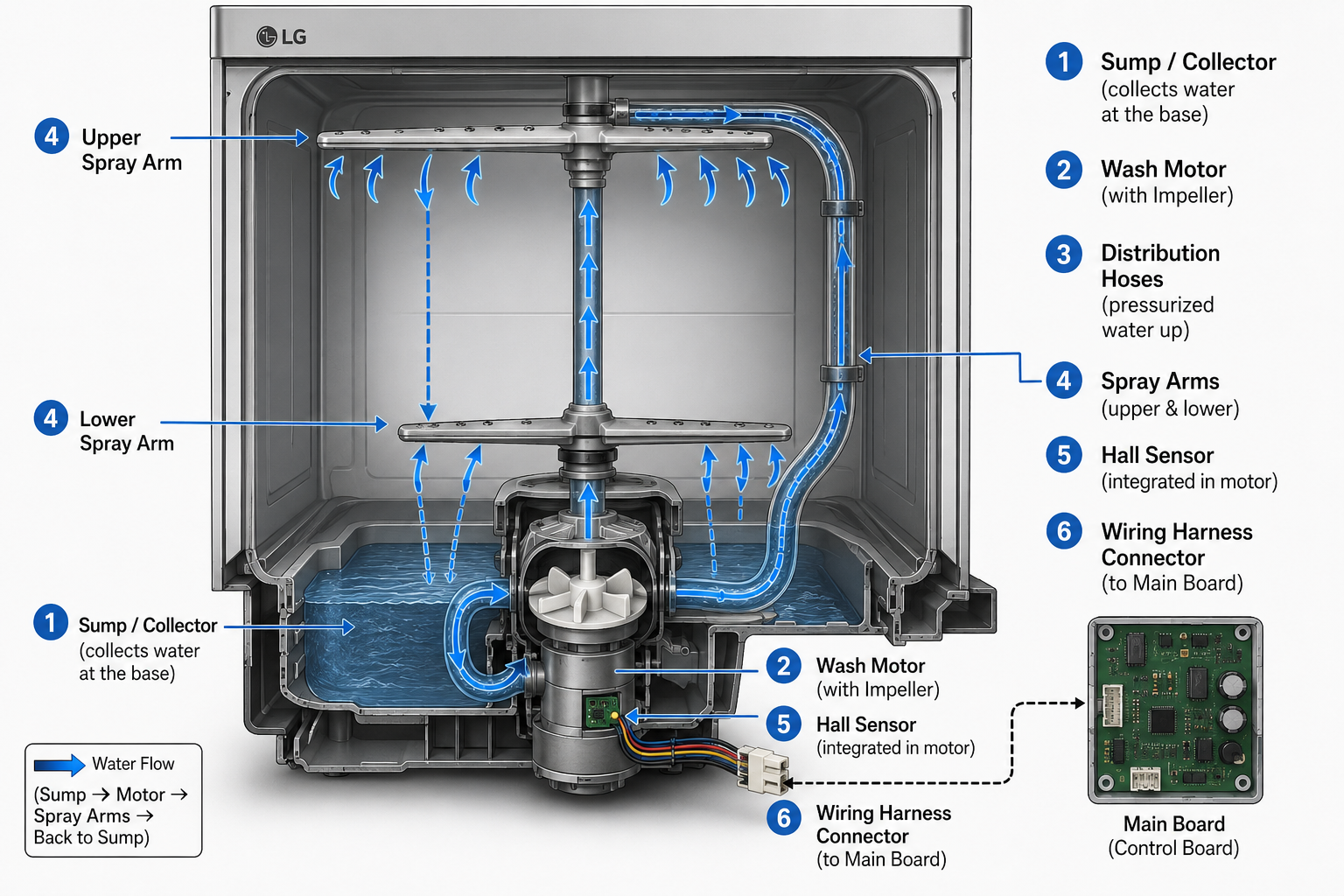
LE stands for "Locked Error" — LG's designation for a wash motor rotation fault. The dishwasher's main control board continuously monitors the circulation pump motor through a hall sensor (a magnetic rotation detector built into the motor assembly). When the board sends power to the motor but receives no rotation feedback — or receives erratic feedback indicating the motor is struggling — it triggers the LE code.
The wash circulation motor is fundamentally different from the drain pump motor. The circulation motor is larger, more powerful, and responsible for pressurizing water through the spray arms at high volume during wash cycles. The drain pump (associated with OE errors) is a smaller motor that only activates to expel water at the end of cycles. An LE error means your dishes are not getting washed because water is not being sprayed — even though the tub may fill normally.
Code variants across LG dishwasher models:
- LE — Standard display on all LG dishwashers manufactured 2015 and later (both front-control and top-control models).
- LE1 — Displayed on some newer LG models (2022+) to specifically indicate a motor winding open circuit, distinguishing it from mechanical blockages.
- E6 — Used on some older LG dishwasher models (pre-2015) for the same wash motor fault.
Important distinction from other LG dishwasher codes:
- LE — Wash motor locked or not rotating (spray arms not working).
- OE — Drain pump fault (water not exiting the machine, different motor entirely).
- AE/E1 — Leak detected in the base pan (float switch triggered).
- FE — Overfill error (water fills above normal level).
- HE — Heater circuit fault (water not heating properly).
If your LG dishwasher displays LE specifically, the problem is always related to the wash circulation motor, its impeller, the wiring harness connecting it to the control board, or the control board itself.
Common Causes of the LG Dishwasher LE Error
Based on LG's official troubleshooting documentation, appliance repair service data, and technician forums, here are the causes ranked by frequency:
1. Debris blocking the circulation pump impeller (approximately 40% of cases)
The impeller is a small fan-like blade inside the circulation pump that spins at high speed to pressurize water. When foreign objects — broken glass, bone fragments, fruit pits, plastic utensils, toothpicks, or accumulated food particles — lodge between the impeller blades or between the impeller and pump housing, the motor cannot rotate. The control board detects zero rotation and triggers LE immediately. This is the most common cause and the most straightforward to fix.
2. Excessive suds overloading the motor (approximately 20% of cases)
Using non-HE dishwasher detergent, regular dish soap (hand wash liquid), or too much detergent creates dense foam that dramatically increases the resistance the impeller must overcome. The motor draws excessive current trying to push through thick suds, the control board interprets this as a locked condition, and triggers LE. LG's official support explicitly identifies oversudsing as a primary LE cause. Even a small amount of hand dish soap (Dawn, Palmolive) accidentally used instead of dishwasher detergent can trigger this.
3. Wiring harness damage or loose connection (approximately 15% of cases)
The circulation pump motor connects to the main control board through a multi-pin wiring harness. Vibration over time, rodent damage, moisture exposure, or a loose connector can interrupt the signal between the motor's hall sensor and the board. When the board loses the hall sensor signal, it assumes the motor is not spinning — even if it actually is — and displays LE. This cause is more common in dishwashers installed in humid environments or homes with pest issues.
4. Failed circulation pump motor (approximately 12% of cases)
The motor itself can fail due to worn bearings (causing seizure), a burned-out stator winding (open circuit), or a degraded oil seal that allows water to infiltrate the motor housing and corrode internal components. Motor failure typically develops gradually: you may notice increasingly poor wash performance (dishes not getting clean) for weeks before the motor finally stalls completely and triggers LE. The most common OEM replacement part number is 4681ED1004B (sump and motor assembly) or ABT72989206 (motor only, model-dependent).
5. Faulty hall sensor within the motor (approximately 8% of cases)
Older LG dishwasher models use a hall sensor (magnetic rotation detector) integrated into the circulation pump to report motor speed to the control board. If this sensor fails or produces erratic readings, the board cannot confirm motor rotation and displays LE — even though the motor may be physically spinning fine. Testing the hall sensor requires measuring resistance between specific pins (Vcc to Ha and Vcc to Hb should both read approximately 10kΩ).
6. Main control board failure (approximately 5% of cases)
The main PCB (printed circuit board) generates the power signals that drive the motor and receives the hall sensor feedback. If the board's motor driver circuit fails (due to a power surge, moisture, or component aging), it either cannot power the motor or cannot read the sensor — both resulting in LE. This is the most expensive repair option and should only be considered after all other causes are eliminated.
Key diagnostic fact: If LE appears immediately at the start of the wash cycle (within 30 seconds of water filling), the cause is almost certainly mechanical (blocked impeller or suds). If LE appears intermittently or after running for several minutes, the cause is more likely electrical (wiring, sensor, or motor winding degradation).
How to Fix the LG Dishwasher LE Error — Step by Step
Follow these steps in order from simplest to most complex. Each step targets a specific potential cause. Most users resolve LE within Steps 1–3 without specialized tools.
Step 1: Power reset (clears temporary glitches)
Before any physical inspection, perform a hard reset to rule out a transient control board glitch:
- Press the Power button to turn off the dishwasher.
- Unplug the unit from the wall outlet or turn off the circuit breaker dedicated to the dishwasher.
- Wait a full 5 minutes (not just 60 seconds — the motor capacitors need time to fully discharge).
- Restore power and attempt a new wash cycle.
If LE does not return, the error was a one-time glitch (possibly a brief power fluctuation or a momentary suds overload that cleared itself). Monitor for recurrence over the next 3–5 cycles.
Step 2: Eliminate suds as the cause
If LE appeared during or shortly after a wash cycle, excessive suds may be the trigger:
- Open the dishwasher door and look inside the tub. If you see foam or suds residue on the walls, door, or filter area, suds are likely the culprit.
- Run a rinse-only cycle with no detergent and no dishes. This flushes residual suds from the system. On most LG models, select the "Rinse" or "Quick Rinse" cycle.
- If suds were present: switch to a proper machine dishwasher detergent (tablet, powder, or gel specifically labeled for automatic dishwashers). Never use hand dish soap, even a drop. Reduce the amount of detergent — most LG dishwashers need only one standard tablet or 1 tablespoon of powder per load.
- After the rinse cycle completes without error, run a normal wash cycle with the correct detergent to confirm the fix.
Step 3: Clear the circulation pump impeller of debris
This is the highest-impact DIY fix for persistent LE errors. The impeller is accessible without removing the dishwasher from the cabinet:
- Turn off power to the dishwasher (unplug or breaker off). This is a safety requirement before reaching into the sump area.
- Remove the lower dish rack to access the tub floor.
- Remove the lower spray arm. On most LG models, it lifts off by turning the center nut counterclockwise, or simply pulling upward (some models have a push-lock clip).
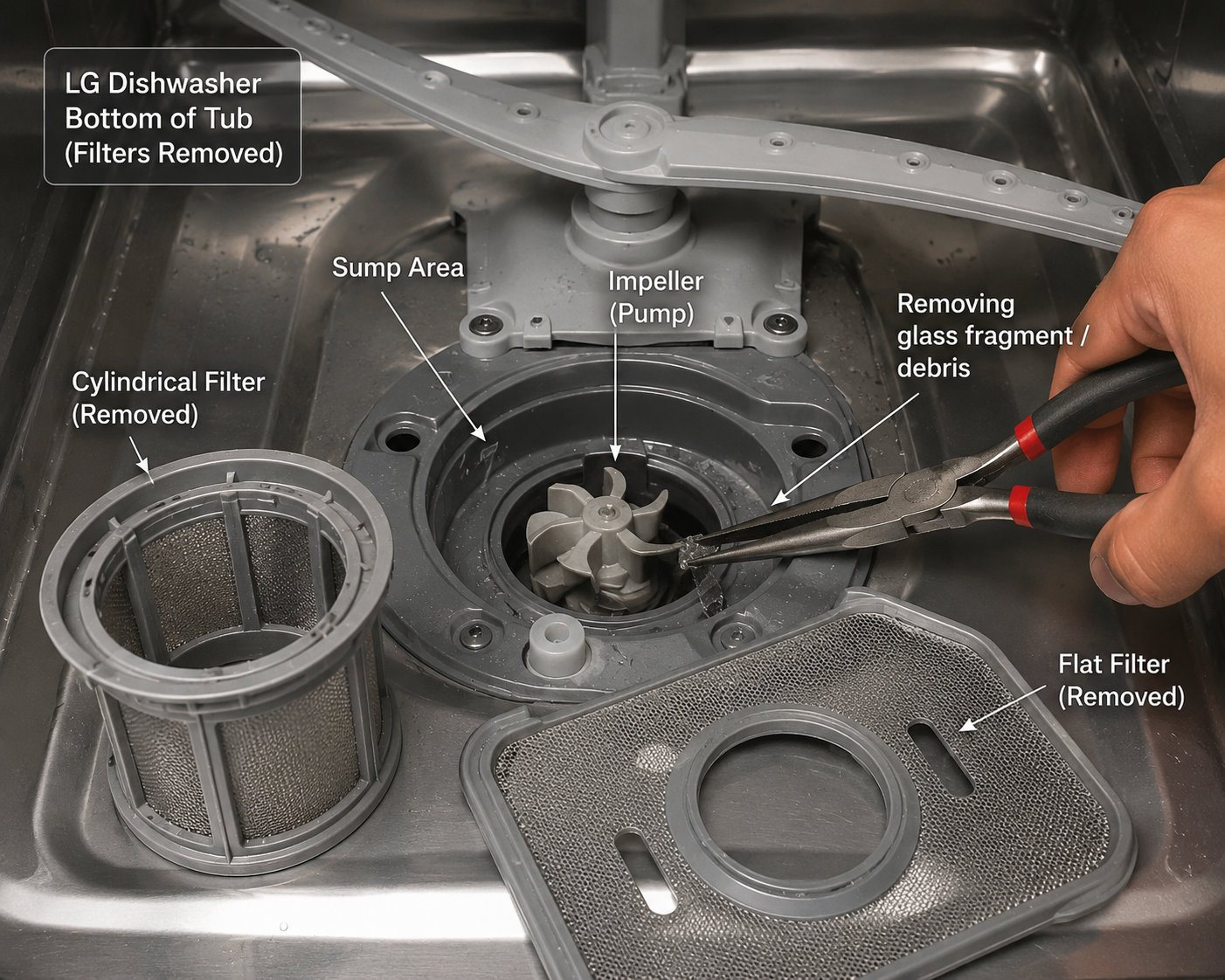
- Remove the mesh filter assembly. LG dishwashers have a cylindrical fine-mesh filter and a flat coarse filter in the sump area. Turn the cylindrical filter counterclockwise and lift it out, then lift the flat filter.
- Access the sump cover/pump cover. With the filters removed, you can see down into the sump (the lowest point of the tub floor). On some models, there is an additional cover plate (2–4 screws) protecting the pump impeller. Remove it if present.
- Inspect and clear the impeller. Look for and remove any debris: glass shards, bones, food particles, plastic pieces, or anything lodged around the impeller blades. Use needle-nose pliers or tweezers for small objects. A flashlight helps visibility.
- Test impeller rotation by hand. Spin the impeller gently with your finger. It should rotate freely in both directions with minimal resistance. If it feels gritty, stiff, or catches, the pump bearings may be worn (see Step 5).
- Reassemble in reverse order: cover plate → flat filter → cylindrical filter → lower spray arm → lower rack.
- Restore power and run a test cycle.
Step 4: Inspect the wiring harness
If the impeller spins freely but LE persists, check the electrical connection between the motor and control board:
- Disconnect power completely (unplug the dishwasher).
- Access the underside of the dishwasher. The wiring harness runs from the circulation pump (mounted at the bottom of the tub) up to the main control board (typically mounted inside the door panel or on the side wall). You may need to remove the kickplate/toe panel (2 screws at the front bottom) to see the motor connections.
- Locate the motor connector. It is a multi-pin white or gray plug connecting the motor to the main wire loom. Disconnect it and inspect both the male and female pins for:
- Corrosion (green or white deposits on the pins)
- Burn marks (blackened or melted plastic around one or more pins)
- Loose fit (the connector does not click firmly into place)
- Moisture inside the connector housing
- Clean any corrosion with electrical contact cleaner spray and a small brush. If pins are burned, the connector or harness needs replacement.
- Reconnect firmly until you hear/feel the locking clip engage. Restore power and test.
Step 5: Test the circulation pump motor
If all previous steps pass but LE continues, test the motor electrically:
- Disconnect power and access the motor connector (as in Step 4).
- Disconnect the motor harness from the motor terminals.
- Set a multimeter to the ohms (Ω) setting (resistance measurement).
- Measure resistance across the motor's power terminals (the two largest pins in the motor connector). A healthy LG dishwasher circulation motor should read approximately 15–25 ohms. An open circuit (OL/infinity) means the motor winding is burned out. A reading near 0 ohms indicates a short circuit. Either reading confirms a dead motor.
- Test the hall sensor (if your model has one — check for additional thin wires, usually 3 or 5 pins alongside the main power pins). Measure between the Vcc pin and each hall output pin. Both readings should be approximately 10kΩ and should match each other. If one reads open or significantly different, the hall sensor is faulty.
- If the motor fails the resistance test: Replace the circulation pump assembly. The most common LG dishwasher wash motor/sump assembly part number is 4681ED1004B (fits LDFN4542, LDP6810, LDT7808, and most front-control models). Price: $80–$180 depending on retailer. Installation involves disconnecting 2–3 hose clamps, the wiring harness, and 3–4 mounting screws — approximately 45–60 minutes for a DIY repair.
Step 6: Consider the main control board (last resort)
If the motor tests good electrically (correct resistance) and the impeller rotates freely, but LE still appears — the main control board may not be sending power to the motor or may not be reading the hall sensor correctly:
- Verify voltage to the motor (advanced — requires a multimeter set to AC volts and the dishwasher powered ON during a cycle, which involves live voltage and carries electrical shock risk). During the wash phase, the board should output approximately 120V AC to the motor terminals. If you measure 0V while the cycle is active, the board's motor relay or triac has failed.
- If no voltage is reaching the motor: Replace the main control board. LG dishwasher control board part numbers are model-specific (commonly EBR86473403 for LDFN4542 series, or EBR89462001 for LDT7808 series). Price: $150–$300 for the board alone.
Important safety note: Testing live voltage (Step 6.1) should only be performed by someone comfortable working with 120V AC. If you are not, this is the step where calling a professional is the correct choice. Do not risk electrical shock.
When to Call a Professional
Contact a certified appliance repair technician if:
- You've completed Steps 1–4 (reset, suds elimination, impeller clearing, wiring inspection) and LE persists on every cycle regardless of detergent type or load.
- The motor resistance test (Step 5) shows an open circuit or short — confirming motor failure — but you are not comfortable performing the physical pump replacement (it requires tilting/sliding the dishwasher and working underneath it).
- You suspect a control board issue (Step 6) — live voltage testing carries electrical shock risk and should only be performed by qualified technicians.
- You notice water leaking from beneath the dishwasher alongside the LE error — this may indicate a failed pump seal allowing water into the motor housing, which is a more complex repair.
- Your LG dishwasher is under warranty — LG provides a standard 1-year full warranty (parts and labor) and a limited 2-year warranty on parts for most dishwasher models. Some models carry a 10-year warranty on the Direct Drive Motor specifically. Attempting DIY repairs on a warranted unit may void coverage.
Average professional repair cost for an LE error: Circulation pump replacement: $200–$400 total (OEM part + labor). Main control board replacement: $250–$450 total. Diagnostic fee: $75–$125, typically credited toward the repair if you proceed with that technician. Average repair time: 45–90 minutes on-site.
For LG warranty service in the United States, contact LG at 1-800-243-0000 or submit a service request at lg.com/us/support. Request an LG-authorized service provider specifically — they have access to OEM parts and can process warranty claims directly. Have your model number (on the label inside the door frame or on the side wall of the tub) and proof of purchase date ready.
LG Dishwasher Models Commonly Affected by LE Error
The LE error code appears across all LG dishwasher lines because all models use the same fundamental DirectDrive or circulation pump motor architecture. These popular series see the highest volume of LE reports based on market share and service data:
Front-Control Models:
- LDFN4542 series (LDFN4542S, LDFN4542B, LDFN4542W, LDFN4542D) — LG's best-selling front-control dishwasher with QuadWash and 3rd rack. 48 dBA. Extremely popular at retail (Best Buy, Lowe's) since 2021.
- LDFC2423 series (LDFC2423V) — Budget-friendly front-control model with wide market penetration.
- LDFN3432T — Older front-control model (2018–2020) with higher LE incidence due to its pump design generation.
Top-Control Models:
- LDT7808 series (LDT7808SS, LDT7808BD) — Premium top-control with TrueSteam and QuadWash Pro. One of LG's flagship dishwashers.
- LDP6810 series (LDP6810SS, LDP6810BD) — Mid-range top-control with Smart Wi-Fi and QuadWash.
- LDTS5552S — Newer top-control model (2023+) with Dynamic Heat Dry and 44 dBA rating.
- LDT5678 series (LDT5678SS, LDT5678BD) — Popular mid-tier top-control with EasyRack Plus.
The diagnostic and repair steps in this guide apply to all LG dishwashers displaying LE, LE1, or E6. The primary differences between models:
- Pump access method: Front-control models have slightly easier bottom access (lower kickplate). Top-control models may require removing an insulation blanket first.
- Part numbers: The sump/motor assembly part number varies by model generation. The most universal replacement is 4681ED1004B, but verify compatibility on LG's parts lookup (lg.com/us/support → enter your model number → Parts & Accessories).
- Hall sensor: Older models (pre-2019) use a separate hall sensor. Newer models integrate the sensor into the motor assembly — if the sensor fails, you replace the entire pump unit.
Preventing Future LE Errors
Once you've resolved the LE error, adopt these practices to prevent recurrence:
- Pre-rinse dishes with heavy food debris. LG dishwashers are designed to handle light food residue without pre-rinsing, but large particles (bones, fruit pits, toothpicks, broken glass) should always be removed before loading. These items bypass the filter system and reach the impeller.
- Use only automatic dishwasher detergent. Never use hand dish soap (Dawn, Palmolive, Ajax liquid) — even a single drop creates excessive suds that can trigger LE. Use tablets, pods, powder, or gel specifically labeled "for automatic dishwashers."
- Use the correct detergent amount. More detergent does not equal cleaner dishes. LG recommends one standard dishwasher tablet or 1 tablespoon of powder/gel per normal load. For soft water areas, reduce further. Excess detergent creates suds buildup over time.
- Clean the filter system monthly. Remove and rinse both the cylindrical fine filter and flat coarse filter under running water. This prevents debris accumulation that could eventually reach the impeller when the filters degrade or overflow.
- Inspect the sump for glass fragments after any breakage. If a glass or ceramic item breaks inside the dishwasher during a cycle, immediately remove all visible pieces from the tub AND check the sump area below the filter. Small glass shards are the number one impeller-damaging debris item.
- Run a monthly maintenance cycle. Use the dishwasher's hottest cycle with a dishwasher cleaner (Affresh, Finish Machine Cleaner) or 2 cups of white vinegar in a bowl on the top rack. This dissolves grease and mineral buildup in the pump system.
- Secure small items in the utensil basket. Small items (baby bottle caps, jar lids, espresso pod holders) can fall through racks during the wash cycle and land in the sump. Use the top rack or a mesh bag for small lightweight items.
Prevention routine that eliminates 90%+ of LE recurrences: remove large food debris before loading, use correct detergent type and amount, clean filters monthly, and inspect the sump after any glass breakage inside the dishwasher.
LE Error vs. Other LG Dishwasher Motor Symptoms
The LE code is the dishwasher's formal alert, but motor problems often show early warning signs before the code appears. Recognizing these symptoms early can prevent a mid-cycle failure:
Early warning signs of circulation pump degradation:
- Dishes not getting clean even though the cycle completes without error — this indicates reduced water pressure from the spray arms, often caused by a partially obstructed or weakening impeller.
- Grinding or humming noise during the wash phase that was not present before — worn pump bearings produce a distinct grinding sound as they degrade.
- Intermittent LE that clears on reset — the motor is struggling but can still start after being power-cycled. This pattern typically worsens over days/weeks until the motor fails completely.
- Longer cycle times — some LG models extend the wash phase when they detect low water pressure, compensating for a weakening pump before finally triggering LE.
When it is NOT the motor (other causes for similar symptoms):
- Spray arms not spinning but no LE code: Check for food debris clogging the spray arm nozzles or a spray arm that has come loose from its mount. This is a spray arm issue, not a motor issue.
- Dishes on top rack not clean: The upper spray arm has a separate feed tube. If it is disconnected or clogged at the junction point, the top rack gets no water — but the motor and bottom spray arm work fine.
- White residue on dishes: This is a hard water/detergent issue, not a motor or pressure problem. Add rinse aid and verify your water softener settings.