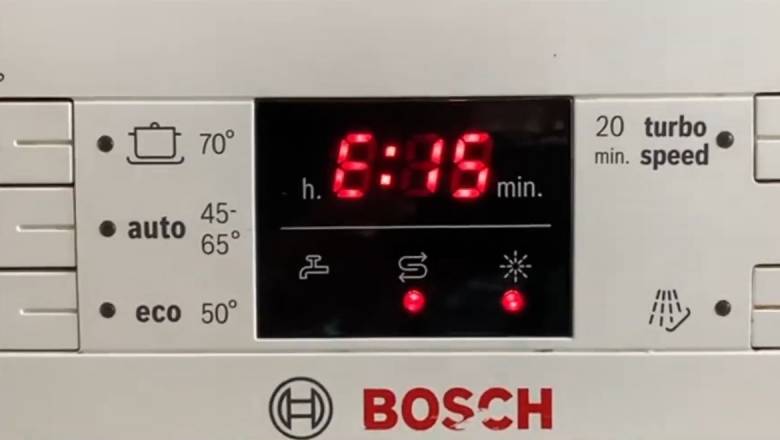
Bosch Dishwasher E15 Error — Causes and Step-by-Step Fix

The E15 error code on a Bosch dishwasher means the AquaStop anti-flood protection system has detected water in the base pan beneath the tub. A float switch inside the base rises when water accumulates, triggering E15, activating the drain pump continuously, and locking out the wash cycle. The most common causes are a worn door gasket, a loose hose clamp, or excessive detergent suds overflowing into the base. The immediate fix is the "tilt method" (tilting the unit 45 degrees to drain t
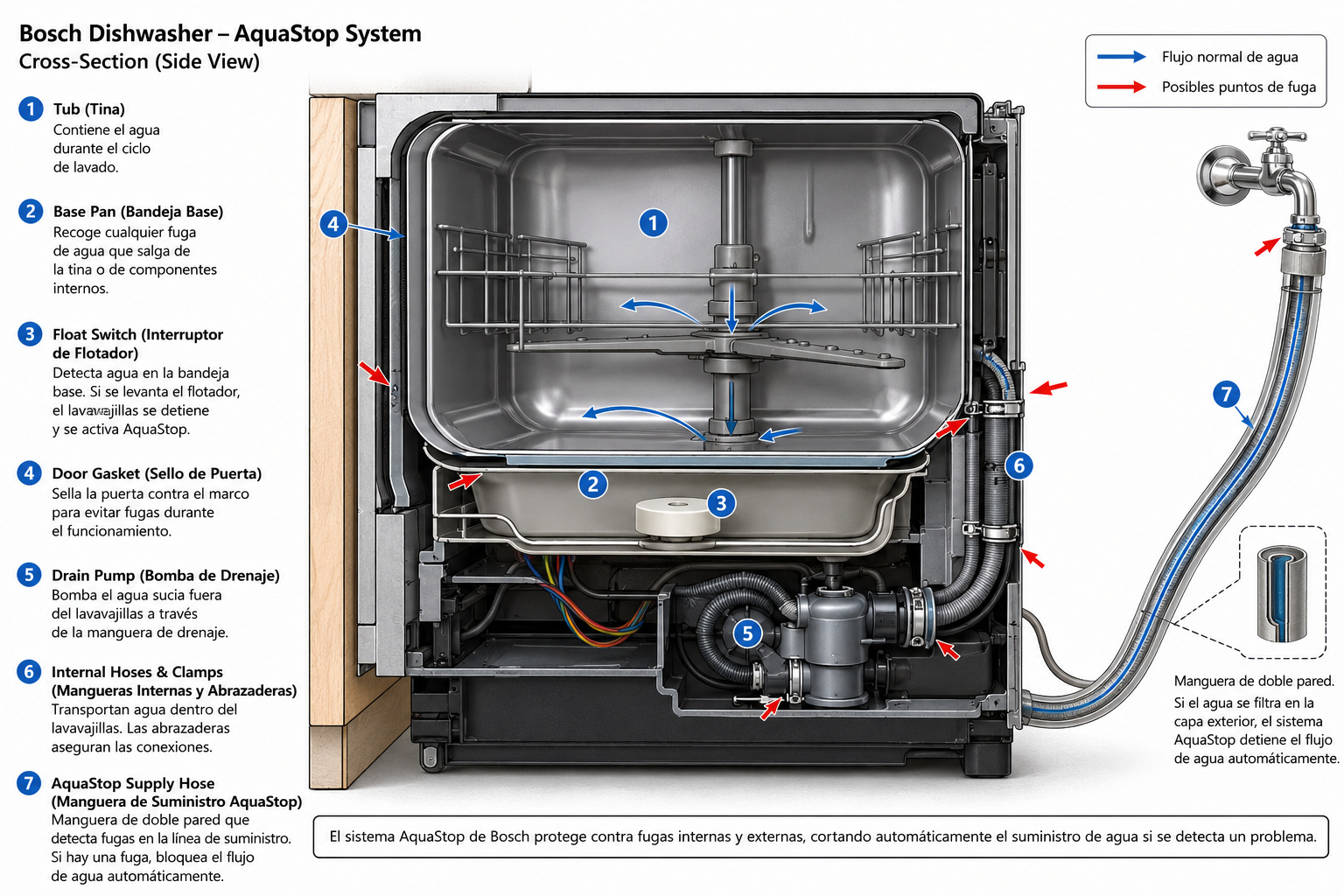
The Bosch dishwasher E15 error code is the AquaStop anti-flood protection alert. Every Bosch dishwasher has a base pan (a metal tray beneath the wash tub) equipped with a float switch — either a Styrofoam disk or a plastic float depending on the model. When water from any internal leak reaches this float, it rises and triggers a safety switch that signals the control board to shut off the water inlet, activate the drain pump continuously, and display E15 on the control panel or flash the corresponding indicator LED.
DIY fix success rate: approximately 85% of E15 errors resolved without a technician. Most common repair: draining the base pan with the tilt method (5 minutes, no tools). Root cause repair cost: $15–$45 for a door gasket or hose clamp. Professional repair cost: $150–$350 including leak diagnosis and part replacement.
Unlike error codes that indicate complex electrical faults, E15 always means one thing: water is where it should not be. The challenge is not clearing the code (that part is simple) but finding and fixing the leak source so E15 does not return. This guide covers both — the immediate reset and the systematic leak diagnosis — with specific part numbers and costs for the most common Bosch dishwasher models.
What Does the E15 Error Code Mean on a Bosch Dishwasher?
E15 is Bosch's designation for "AquaStop activated — water detected in base pan." The AquaStop system is a multi-layer flood protection system that Bosch includes in all its dishwashers. It consists of three independent safety components working together:
- Double-walled supply hose: The water inlet hose has an inner and outer wall. If the inner hose fails, water is contained within the outer wall and triggers a mechanical shutoff valve at the tap connection.
- Mechanical shutoff valve: Located at the water tap end of the supply hose, this valve closes automatically if the inner hose leaks.
- Electronic float sensor (the E15 trigger): A float switch inside the base pan beneath the dishwasher tub. When any internal leak — from the tub, door seal, pump, hoses, or spray arms — drips water into the base pan, the float rises and the control board receives the E15 signal.
When E15 activates, the dishwasher immediately:
- Cuts off water supply to the unit (closes the inlet valve).
- Activates the drain pump to run continuously (you will hear it buzzing even when the dishwasher is "off").
- Locks out all wash programs — the machine will not start a new cycle until the base is dry and the float drops.
Important distinction from other codes:
- E15 — Water in the base pan (leak detected below the tub).
- E17 — Overfill protection (water level too high inside the tub itself).
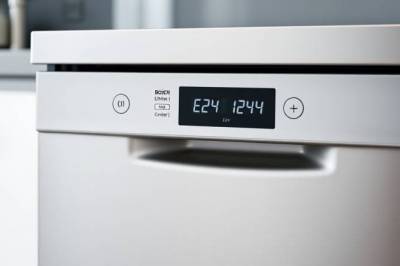
- E24/E25 — Drain issues (water cannot exit the machine through the drain hose).
- E09 — Heating element fault (completely unrelated to water leaks).
If your Bosch dishwasher displays E15 specifically, the problem is always a leak that has allowed water to reach the base pan. The drain pump running continuously is normal behavior — it is the machine trying to pump leaked water out of the base. This pump will continue buzzing until you resolve the issue or disconnect power.
Common Causes of the Bosch Dishwasher E15 Error
Based on service data from appliance repair providers and Bosch's own troubleshooting documentation, here are the causes ranked by frequency:
1. Worn or damaged door gasket (approximately 35% of cases)
The door gasket (also called door seal or tub seal) is the rubber strip that runs along the perimeter of the dishwasher tub opening, sealing against the door when closed. Over time — typically after 5–8 years of regular use — this gasket hardens, cracks, or deforms, allowing small amounts of water to seep past the seal during wash cycles. The water drips down the front of the tub and into the base pan below. The most common Bosch door gasket part number is 00494772 (upper tub seal), compatible across most Bosch, Thermador, and Gaggenau dishwashers. A lower door seal (part 00744884) may also be involved.
2. Excessive detergent or wrong detergent type (approximately 20% of cases)
Using regular dish soap instead of dishwasher-specific detergent, or using too much detergent in soft water areas, creates excessive suds that overflow the tub during the wash cycle. The foam rises above the normal water line and seeps through the door seal or spray arm housing into the base pan. This is especially common after switching detergent brands or when a household has a water softener installed.
3. Loose or cracked internal hose clamp (approximately 18% of cases)
Inside the dishwasher, several hoses connect the pump, tub, spray arms, and drain system. These hoses are secured with spring or worm-drive clamps that can loosen over time due to thermal cycling (heating and cooling with each wash). A loose clamp allows water to weep at the connection point, eventually accumulating enough in the base pan to trigger E15. The most common leak points are the pump-to-tub connection and the recirculation hose connection.
4. Cracked or worn spray arm (approximately 12% of cases)
A cracked spray arm can direct a concentrated stream of water at the door seal rather than distributing it evenly across dishes. This focused spray can overwhelm the seal at a specific point and force water past it. A worn spray arm bearing or loose spray arm nut can also cause wobble that sends water toward the door edge.
5. Failed water inlet valve (approximately 8% of cases)
The water inlet valve (solenoid valve) controls water entry into the dishwasher. If the valve fails in the partially-open position or develops a slow drip when closed, water can continuously trickle into the tub even when the dishwasher is off. Eventually the tub overflows into the base pan. This is often noticed as E15 appearing when the dishwasher has not been run recently.
6. Cracked pump housing or sump seal failure (approximately 5% of cases)
The wash pump and sump assembly at the bottom of the tub can develop hairline cracks or seal failures that allow water to drip downward into the base pan during operation. This is more common in older units (8+ years) and typically manifests as E15 appearing mid-cycle or immediately after a cycle completes.
7. Condensation buildup from improper installation (approximately 2% of cases)
If the dishwasher is installed without proper ventilation or with the steam vent blocked, condensation from hot wash cycles can accumulate over time in the base pan. This is a slow-building problem that may take weeks or months to trigger E15.
Key diagnostic fact: Approximately 55% of E15 errors (causes #1 and #2 combined) are resolved without replacing any parts — just by cleaning up excess suds, replacing the door gasket ($15–$45), or tightening a hose clamp. Only about 13% of cases require expensive component replacement (inlet valve or pump housing).
How to Fix the Bosch Dishwasher E15 Error — Step by Step
This guide has two phases: Phase 1 is clearing the immediate error (getting the dishwasher working again), and Phase 2 is finding and fixing the root cause (preventing E15 from returning). Most users can complete Phase 1 in under 10 minutes.
Phase 1: Clear the E15 Error (Immediate Fix)
Step 1: Turn off power and water supply
- Turn off the dishwasher using the power button.
- Disconnect from power — either unplug it or turn off the circuit breaker. The drain pump will stop buzzing.
- Close the water supply valve under the kitchen sink (the valve on the pipe leading to the dishwasher). Turn it clockwise until it stops.
- Place towels on the floor around and in front of the dishwasher.
Step 2: The Tilt Method (drain the base pan)
This is the most effective immediate fix for E15. The goal is to physically drain the trapped water from the base pan so the float switch drops back down:
- Pull the dishwasher forward — Carefully slide the unit out from under the counter. Most Bosch dishwashers are mounted with 2 screws at the top (into the underside of the countertop) and may have anti-tip brackets. Remove the mounting screws first.
- Tilt the dishwasher backward at approximately 45 degrees. Have someone help you hold it, or lean it against a stable support. Keep towels underneath.
- Hold for 30–60 seconds. Water trapped in the base pan will drain out toward the back and bottom of the unit. You may see anywhere from a few tablespoons to a cup of water flow out.
- Return the dishwasher upright and slide it back into position (do not remount yet — wait until you verify the fix works).
Step 3: Reset and test
- Reconnect power (plug in or turn on the breaker).
- Open the water supply valve.
- Power on the dishwasher.
- Start a short wash cycle (e.g., Rinse or Quick Wash).
- Monitor closely for the first 5–10 minutes. If E15 does not return and no water appears under the unit, the immediate issue is resolved.
If E15 returns immediately or within the first cycle: The leak source is still active. Proceed to Phase 2.
If E15 does not return: The cause may have been a one-time event (suds overflow, splash during loading). Monitor over the next 3–5 wash cycles. If E15 stays away, the issue was transient. If it returns intermittently, proceed to Phase 2 to find the slow leak.
Phase 2: Find and Fix the Leak Source (Root Cause Repair)
Step 4: Run a test cycle with the door open (leak inspection)
To identify the leak source, you need to see where water escapes during operation:
- Pull the dishwasher out enough to access all sides while still connected to water and power.
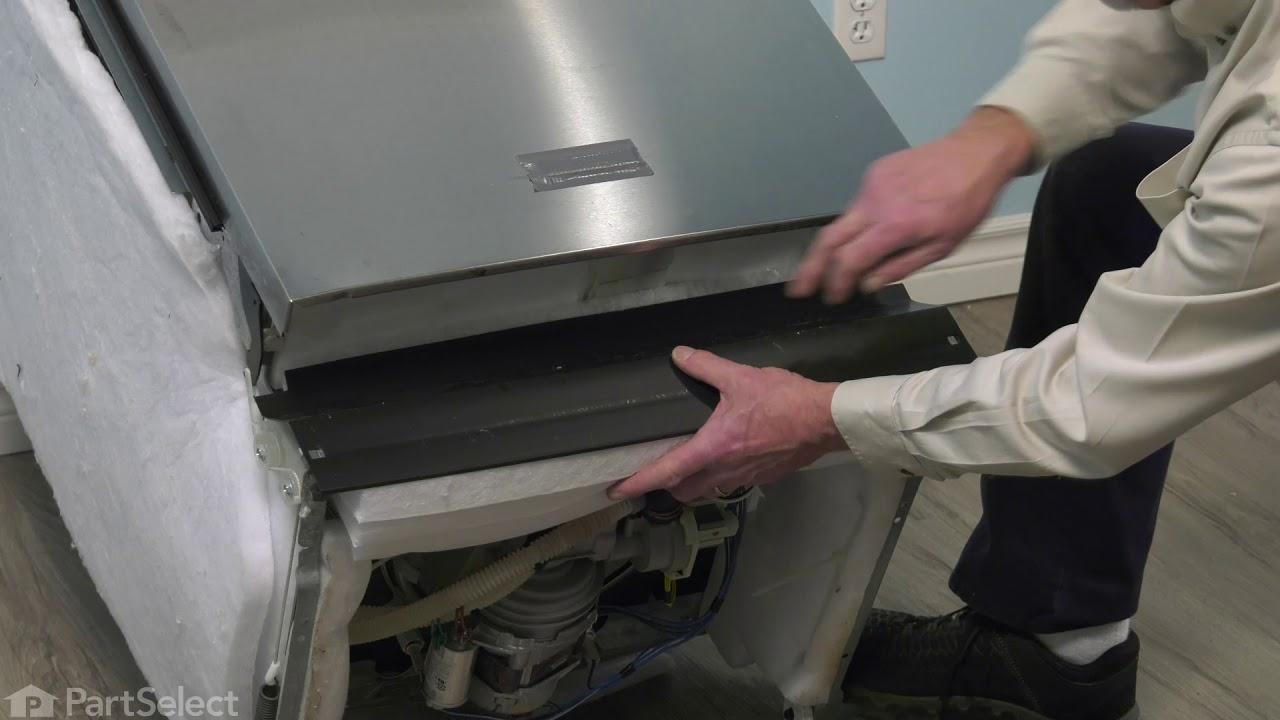
- Remove the bottom kickplate panel (typically held by 2 Torx T20 or Phillips screws at the bottom front).
- Place a bright flashlight under the unit pointing up at the base pan area.
- Start a wash cycle and watch carefully around: the door seal edges (front), the pump and sump area (bottom center), and the hose connections (sides and back).
- Look for drips, streams, or water weeping at any connection point.
Step 5: Inspect and replace the door gasket (most common fix)
If you see water seeping around the door edges during the wash cycle:
- Open the door and inspect the gasket visually. Run your fingers along the entire perimeter. Feel for hardened sections, cracks, tears, gaps, or areas where the rubber has flattened and lost its elasticity.
- Check for food debris or mineral deposits lodged in the gasket channel — these can prevent a proper seal.
- Clean the gasket — Wipe with a damp cloth and white vinegar to remove buildup. If the gasket is physically intact but dirty, cleaning alone may resolve the leak.
- Replace if damaged — The Bosch upper door gasket 00494772 fits most models and installs without tools (it presses into a channel around the tub opening). The lower door gasket is part 00744884. Priced $15–$45 from appliance parts retailers. Installation takes 10–15 minutes.
Step 6: Check for excess suds
If you noticed excessive foam during your test cycle:
- Switch to a low-sudsing dishwasher detergent. Bosch recommends Finish or Cascade formulations specifically designed for dishwashers. Never use regular dish soap.
- Reduce the amount. Many users overfill the detergent dispenser. For most Bosch models, one standard dishwasher tablet or 1 tablespoon of powder/gel is sufficient. In soft water areas, use even less.
- Run 2–3 empty cycles with no detergent to flush residual suds from the system.
Step 7: Inspect internal hose connections
If the leak is not from the door area:
- With the kickplate removed and power off, visually inspect every hose connection inside the base area. Look for moisture, mineral deposits (white residue = old dried leak), or corrosion at clamp points.
- Check the pump connections — The recirculation pump and drain pump have hose connections secured with spring clamps. Squeeze the clamp ears with pliers, reposition the clamp directly over the hose barb, and release. This takes 2 minutes per connection.
- Check the sump-to-tub connection — The sump (bottom of the tub where water collects) connects to the pump system. This seal can deteriorate. If water weeps from this area, the sump gasket needs replacement.
Step 8: Test the water inlet valve
If E15 appeared when the dishwasher was not running (water entered while idle):
- With the dishwasher off and door closed, watch the tub for 30 minutes. If the water level inside the tub rises slowly, the inlet valve is leaking through (not closing fully).
- The inlet valve is located behind the kickplate area, where the supply hose connects to the dishwasher. Common Bosch inlet valve part numbers include 00622058 and 00645701, priced $40–$80.
- Replacement requires disconnecting the supply hose, removing 1–2 mounting screws, disconnecting the electrical connector, and installing the new valve. A 20–30 minute job.
When to Call a Professional
Contact a certified appliance repair technician if:
- You have performed the tilt method and leak inspection (Steps 1–8) but cannot identify the leak source — some internal leaks from the sump seal or pump housing are only visible with the unit fully removed and inverted.
- The E15 error returns within 1–3 cycles after every tilt — this indicates a persistent active leak that requires component access beyond the kickplate area.
- You see water coming from the pump housing or the bottom of the tub (sump area) — these repairs require removing the dishwasher completely and potentially replacing the pump assembly or sump seal.
- The inlet valve is leaking through (water enters when dishwasher is off) and you are not comfortable working with water supply connections.
- Your Bosch dishwasher is still under warranty — Bosch provides a standard 1-year parts and labor warranty, and some models include a 5-year limited warranty on the AquaStop system (check your documentation or the purchase date).
- You detect a burning smell or see corrosion on the control board — water intrusion into the electronics can cause short circuits that require professional diagnosis.
Average professional repair cost for an E15 error: $150–$350 total (diagnosis + parts + labor). Diagnostic fee: typically $75–$125, often waived if you proceed with repair. Door gasket replacement by a technician: $120–$200 total. Inlet valve replacement: $180–$300 total. Pump or sump seal replacement: $250–$450 total.
For Bosch warranty service or to find an authorized service provider in the US, contact Bosch Home Appliances at 1-800-944-2904 or schedule service online at bosch-home.com/us/support. In Canada, call 1-800-828-9165. Bosch uses its own BSH-certified technicians for warranty work, which guarantees OEM parts and proper diagnosis.
Bosch Dishwasher Models Commonly Affected by E15
The E15 error code can appear on any Bosch dishwasher with the AquaStop system — which is all models sold since approximately 2010. However, these series are most frequently reported due to their high sales volume and specific design characteristics:
800 Series (Premium line — most common in E15 reports):
- SHPM88Z series (SHPM88Z75N, SHPM88Z55N) — 24" top control, 800 Series, MyWay rack. Panel-ready and stainless variants.
- SHP88PZ series (SHP88PZ55N) — 24" built-in, 800 Series, CrystalDry technology.
- SHPM78Z series (SHPM78Z55N) — 24" pocket handle, 800 Series with third rack.
500 Series (Mid-range):
- SHPM65Z series (SHPM65Z55N) — 24" top control, 500 Series, AutoAir drying.
- SHP65T series (SHP65T55UC) — Older 500 Series, pocket handle design.
- SHPM55Z series (SHPM55Z55N) — 24" fully integrated, 500 Series.
300 Series (Entry-level):
- SHSM63W series (SHSM63W55N) — 24" scoop handle, 300 Series.
- SHS863WD series (SHS863WD5N) — Bar handle variant, 300 Series.
100 Series (Budget line):
- SHSM4AZ series (SHSM4AZ55N) — 24" budget option with basic AquaStop.
The diagnostic and repair steps in this guide apply to all Bosch dishwashers displaying E15. The door gasket part (00494772) is compatible across most Bosch, Thermador, and Gaggenau dishwashers manufactured by BSH. The only variation between models is the kickplate attachment method (screws vs. clips) and the specific inlet valve part number. Always verify your model's specific parts on the nameplate located on the left or right side of the door frame interior.
Note: BSH Home Appliances (Bosch's parent company) also manufactures Thermador, Gaggenau, and some Kenmore dishwashers. If you have a Thermador or Gaggenau dishwasher showing E15, this guide applies equally — the AquaStop system, float switch design, and internal components are identical.
The AquaStop System Explained
Understanding how AquaStop works helps you prevent future E15 errors and appreciate why the system exists. Bosch's AquaStop is one of the most comprehensive dishwasher leak protection systems available, with a lifetime guarantee against water damage from system defects on most models.
Layer 1: Double-walled supply hose
The water supply hose connecting your home valve to the dishwasher is not a standard single-wall hose. It has an inner hose (carrying pressurized water) surrounded by an outer hose. If the inner hose develops a leak or rupture, water is contained within the outer hose and flows toward a mechanical shutoff valve at the tap end. This prevents flooding even if the inner hose completely fails.
Layer 2: Mechanical shutoff valve
At the point where the AquaStop hose connects to your household water valve, there is a mechanical safety valve. If water pressure between the two hose walls exceeds normal (indicating an inner hose leak), this valve closes mechanically — no electricity required. This means it works even during a power outage.
Layer 3: Electronic float sensor (E15 trigger)
The base pan float is the final safety layer for any leak inside the dishwasher itself (from the tub, door, pump, or internal hoses). When water reaches the float, the control board receives the signal, cuts off the inlet valve electronically, and runs the drain pump to evacuate as much water as possible from the base pan.
The three layers together cover every possible leak scenario:
- Supply hose failure → Layer 1 + Layer 2 (mechanical, no power needed)
- Internal component leak → Layer 3 (electronic, triggers E15)
- Both simultaneously → All three layers activate
The AquaStop lifetime guarantee: Bosch guarantees that if their AquaStop system fails to prevent water damage from an internal dishwasher leak (meaning the system itself malfunctions), they will cover the resulting water damage. This guarantee lasts the lifetime of the dishwasher. However, this does NOT cover situations where E15 activates correctly in response to a real leak — that is the system working as designed and protecting your home.
Preventing Future E15 Errors
Once you have resolved the E15 error and fixed the leak source, follow these maintenance practices to prevent recurrence:
- Use only dishwasher-specific detergent. Never use regular dish soap (even a small squirt causes massive suds). Use Finish, Cascade, or similar dishwasher-formulated products. If you have soft water or a water softener, reduce the detergent amount by 25–50% from the manufacturer's recommendation.
- Inspect the door gasket every 6 months. Open the door and run your fingers along the entire seal perimeter. Feel for hardening, cracking, or areas where the rubber has lost elasticity. Clean the gasket with a damp cloth and white vinegar to remove mineral deposits and food residue that can degrade the seal.
- Do not overload the lower rack near the door. Tall items (cookie sheets, cutting boards) placed against the front of the lower rack can press against the door seal during the cycle, creating a gap that allows water to escape.
- Check the spray arms for cracks periodically. Remove the lower and upper spray arms (they usually twist off counterclockwise) and inspect for hairline cracks, especially near the water inlet bearing. A cracked spray arm is inexpensive to replace ($15–$30) but can cause persistent door seal leaks if left unaddressed.
- Keep the filter clean. A clogged drain filter causes water backup in the tub, which increases the water level during drain phases and can push water past the door seal at the bottom. Clean the cylindrical filter assembly after every 20–30 cycles.
- Ensure proper installation level. A dishwasher that is not level (front higher than back, or tilted to one side) can cause water to pool at an incorrect point during the cycle, overwhelming the seal at that location. Use a spirit level on the top of the tub and adjust the front legs until perfectly level.
- Never modify or bypass the AquaStop system. Some online guides suggest taping the float down or disconnecting the sensor to "permanently fix" E15. This is extremely dangerous — the AquaStop system exists to prevent catastrophic water damage to your home. A malfunctioning dishwasher without flood protection can release 6–10 gallons per minute if a hose bursts.
Maintenance schedule that prevents 90%+ of E15 errors: door gasket inspection every 6 months, filter cleaning every 20–30 cycles, spray arm inspection annually, correct detergent type and amount at every use. The door gasket is the single most impactful component — replacing it proactively every 6–8 years ($15–$45) prevents the majority of E15 occurrences.